
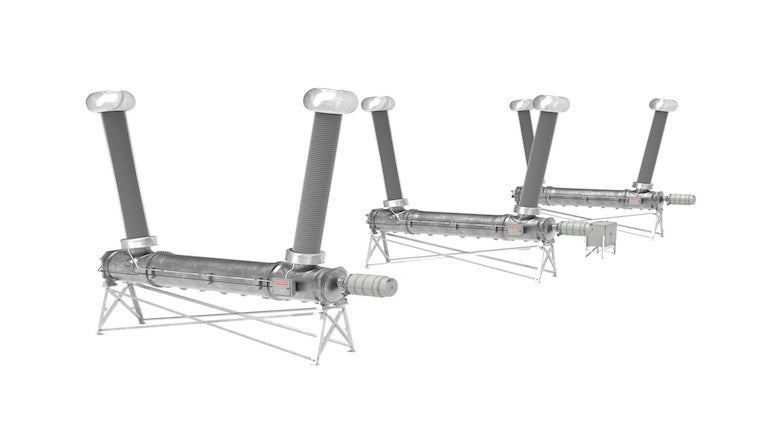
On 5 May at the IEEE PES T&D Conference in Chicago Hitachi Energy unveiled its new design of SF6–free circuit breaker, the EconiQ dead tank circuit breaker, a technology designed for 800 kV 63 kA and 420 kV 80 kA systems. Hitachi believes it sets a new benchmark for high-voltage transmission, being engineered for the world’s most demanding grids, and combining ‘uncompromising’ reliability with sustainability, a step toward resilient, future-ready transmission grids.
For much of the industry’s history, SF6 has been a necessity for achieving reliable insulation and interruption at the highest voltages, with the replacement of SF6 gas from high-voltage equipment being viewed as a technical challenge and a social imperative.
The technology addresses a longstanding challenge in high-voltage engineering of eliminating SF6 while maintaining system reliability and dielectric performance. The highest ratings ever realised without SF6 are to be applied in North America’s new ultra-high voltage transmission grid.
New roadmap
Alongside the unveiling of the 800 kV DTB, the company is also advancing its EconiQ high voltage switchgear roadmap, the new voltage levels moving Hitachi’s range towards a complete SF6-free HV. The roadmap introduces new voltage levels in 2026, including 170 kV, 40 kA and 800 kV, 50 kA solutions for live-tank circuit breakers. This coverage of voltage levels could enable utilities to transition seamlessly toward fully SF6-free substations. Eliminating SF6 at the upper end of the voltage and current spectrum avoids the long-term environmental liability of infrastructure remaining in service for half a century or more.
These EconiQ breakers are intended for the backbone of long-distance transmission systems that move power across regions and support entire cities, industries, and transportation networks. Making SF6-free operation viable at these voltages, says Hitachi, shifts environmental responsibility from the periphery of the grid to its core.
800 kV switchgear is seeing a strong early adoption from utilities and grid operators. It is expected that when the new switchgear is installed, operators will not notice any difference to traditional equipment.


