
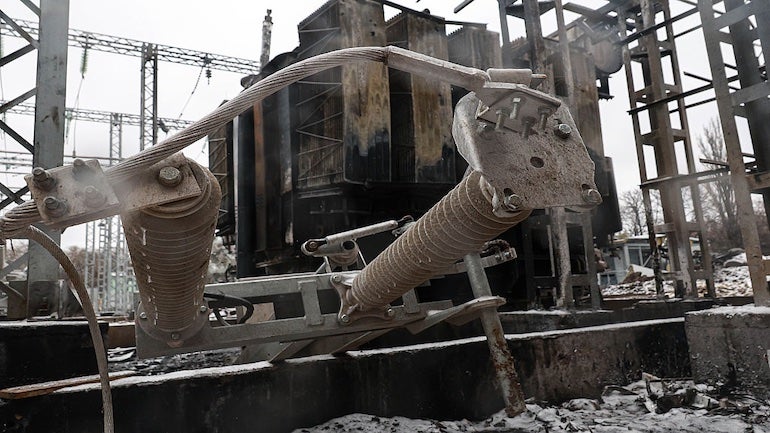
On 22 February Russia attacked Ukraine with dozens of strike drones and ballistic and cruise missiles, focusing on energy infrastructure and killing at least one person, the Ukrainian military and local officials said, as reported by Reuters. The overnight strikes hit Kyiv and the region around the capital, the Black Sea port of Odesa and central Ukraine.
President Volodymyr Zelenskiy of Ukraine said on X that the strikes also targeted the Dnipro, Kirovohrad, Mykolaiv, Poltava and Sumy regions. The main target of the attack was the energy sector, but residential buildings and railway were also damaged, he noted.
Zelenskiy added that in one week, Russia launched more than 1300 drones, more than 1400 guided aerial bombs and 96 missiles against Ukraine.
Progress on a USA brokered peace deal has been halting, with Russia demanding that Ukraine withdraw from parts of the eastern Donbas region it still controls, an idea Kyiv has rejected.
At least one person was killed and another five were wounded in the Kyiv region, with damage reported in five districts where more than a dozen houses were damaged, regional Governor Mykola Kalashnyk said on the Telegram messaging app.
Odesa Governor Oleh Kiper wrote on Telegram that a night-time drone attack on the energy infrastructure of the region caused fires that had been extinguished.
The Ukrainian air force said that Russia had launched 50 missiles and 297 drones in overnight attacks and air defence units shot down or neutralised 33 missiles and 274 drones.
Russia is said to be attacking the Ukrainian energy system almost daily, striking thermal power plants and electrical substations.
Moscow denies targeting civilians but says Ukraine’s civil infrastructure is a legitimate target because striking it can reduce Kyiv’s ability to wage war. Kyiv says the aim is to harm civilians and break the country’s will.
Attacks in January
In January Russian armed forces conducted near-daily attacks on Ukraine’s energy infrastructure, including five large-scale attacks in which several regions were targeted simultaneously. The attacks damaged or destroyed key components of the energy system in at least 17 regions of Ukraine, as well as in Kyiv city.
These systematic and repeated attacks by the Russian Federation have created extreme hardship for the civilian population, the United Nations Monitoring Mission in Ukraine reported on 13 February in its monthly update on civilian harm. The attacks, which continued into February, have caused extensive disruptions to electricity, heating, and water across the country, affecting millions, as temperatures consistently remained below freezing.
HRMMU visited temporary camps, hospitals, and educational facilities in areas most affected by the outages, documenting their impact on people’s lives during one of the harshest winters in recent years.
The scale and persistence of these attacks underscore a grave disregard for the lives and well-being of civilians,” said Danielle Bell, head of HRMMU. “When power, heating, and water are repeatedly knocked out in the dead of winter, basic survival becomes a daily struggle.” They caused prolonged electricity outages across the country, which also resulted in disruption to heating and water services, particularly in multi-story buildings. Millions of people were left with access to electricity for just a few hours per day, throughout the month.
At least 161 civilians were killed and 757 injured across Ukraine in January, which is similar to the number in January 2025. Attacks with long-range weapons (missiles and drones) launched by the Russian armed forces caused 39 % of all civilian casualties (54 killed; 305 injured), usually affecting urban centres far from the frontline. The majority of casualties occurred near the frontline (97 killed; 444 injured), with short-range drones remain the primary cause of civilian harm (54 killed; 207 injured).


